The Best Office Desks in 2026: Standing Desks Won, Here's What to Buy
Some links in this guide are affiliate links - we may earn a commission at no extra cost to you.
Somewhere in the last few years the office desk stopped meaning a slab on four legs and started meaning a motorized frame, and for anyone working from home full time that shift is good news. A solid dual-motor standing desk is one of the few upgrades that pays you back every single day, because the win is not standing for eight hours - it is being able to change position the moment your back asks you to. Do that on an electric frame with memory presets and there is zero friction to it. The trouble is that the market is flooded with wobbly single-motor frames that undercut the good ones on price and give the whole category a bad name, so knowing what actually matters is the entire game.
Four things decide whether a standing desk is worth owning. The motor and frame come first: dual-motor frames stay planted at full height where cheap single-motor ones sway and rack. Then the height range, which has to drop low enough for correct sitting posture and rise high enough for your standing height. Then the surface - a one-piece top wide enough for your monitors, with 28-30 inches of depth to keep screens an arm's length from your eyes. And finally the warranty, because a long one is a company quietly telling you how many years the frame is built to survive. The part most guides skip is that the real reason an adjustable desk matters is not standing at all: most fixed desks are simply the wrong height for most humans. The 29-to-30-inch standard predates computers, while correct typing posture for an average-height person wants closer to 27-28. An electric desk fixes your sitting ergonomics on day one, and the standing option is the bonus.
How we rank: we weigh the things that decide whether you keep using a standing desk a year later - frame stability at full height, motor type and noise, lift capacity, the honesty of the warranty, and how much desk you get per dollar. We cross-check prices against live Amazon and Newegg listings and favor frames with a long track record over whatever is cheapest this week.
The short version
The office desk category quietly became the standing desk category, and the podium is settled. Buy the Uplift V2 if you want the desk every other one gets measured against - rock-solid at full height, endlessly configurable, backed by a 10-year warranty that tells you how long it lasts. If you would rather keep the difference, the Flexispot E7 Series gives you nearly the same desk for $120-200 less, and the Flexispot entry line delivers honest electric adjustability for around $170-250 right now. Fixed desks only win when the budget is under $150.
Best overall: Uplift V2 Standing Desk
The Uplift V2 is the desk every other standing desk gets measured against, and for a full-time work-from-home setup it is the closest thing to a buy-once decision. What you are paying for is the frame. Its dual-motor lift stays rock-solid at full standing height, which is exactly where cheaper single-motor frames start to sway, the motors are quiet enough to raise mid-call, and the rated 355-pound capacity means a triple-monitor arm and a heavy top never faze it. The height range covers short and tall users alike, and the top sizes and finishes are effectively endless if you want a specific footprint.
The honest tradeoff is the price: it is $599 before you add a single accessory, so it only makes sense if you value stability and longevity over saving money up front. The tell is the 10-year warranty - that is the company betting on how long the frame lasts, not just how long it will field a claim. If you are tall, hard on furniture, or you simply want to stop shopping the category forever, this is the one to pay up for.
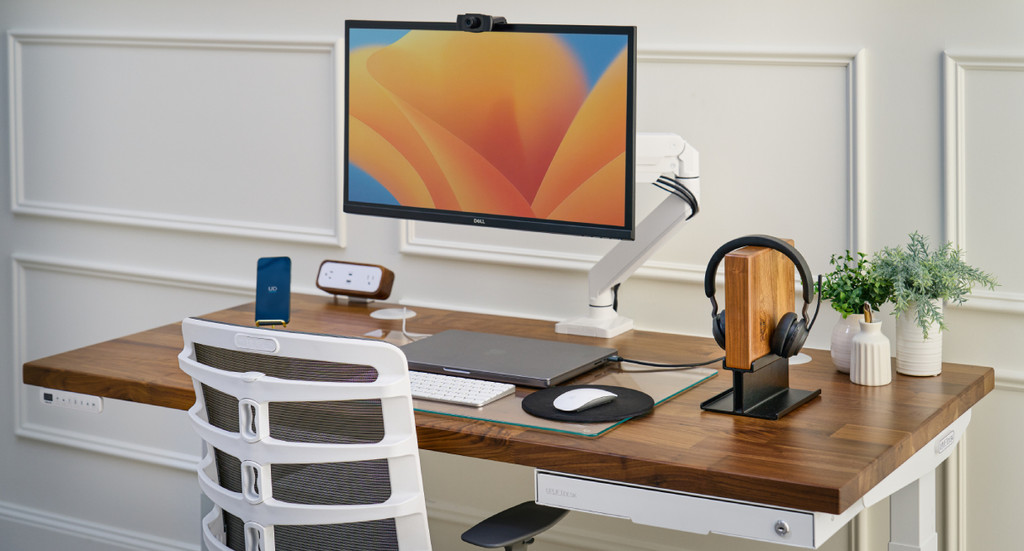
The buy-it-once benchmark. If you are tall, load it heavy, or just want to forget the desk category exists for a decade, this is the frame that earns the premium.
The catch: It is $599 before you add a single accessory - you are paying for stability and a decade of warranty, not extra features, so justify it as a long-term tool rather than a bargain.
Best value: Flexispot E7 Series
If the Uplift is the benchmark, the E7 is the desk most people should actually buy. Flexispot's flagship dual-motor frame matches the premium desks on lift capacity and speed, adds a programmable keypad with memory presets and built-in cable management, and does it for $120-200 less at the same 55-inch footprint. That width comfortably handles a dual-monitor or ultrawide setup, and at normal sitting and low-standing heights it feels every bit as planted as desks that cost more.
Where it gives ground is at the extremes. There is a little more flex at maximum standing height than the Uplift shows, and the warranty is five years against ten. Neither shows up in day-to-day use for an average-height person, which is where most of us actually work. Spend up to the benchmark only if you are tall or genuinely rough on your furniture. For everyone else this is where the money should go - you pay noticeably less and give up almost nothing you will ever notice.
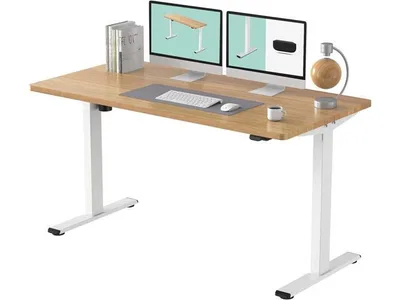
The rational pick for most people - nearly the Uplift at $120-200 less. Unless you are tall or hard on furniture, this is where the money belongs.
The catch: It gives up a little stability at maximum height and half the warranty versus the Uplift, so tall users and heavy loaders are the ones who should still spring for the benchmark.
Budget electric: Flexispot Electric Standing Desk
This is the desk that ended the fixed-desk value argument. You get a one-piece 48-by-30 top, real electric height adjustment, and one-touch memory presets for around $170-250 depending on sale timing. For a normal single-PC setup that is the entire ergonomic payoff of the category - the correct sitting height dialed in on day one, and the one-touch switch to standing - at a fraction of a flagship's price.
The frame is lighter-duty than the E7, and you feel it if you push it. Stack heavy monitors and it shows a bit of wobble at full height, and the 48-inch width is realistically single-monitor territory, so treat this as a solo-screen desk rather than a multi-panel battlestation. But if you have been on the fence about whether electric adjustment is worth paying for, this is the cheapest way to prove to yourself that it absolutely is, and you are risking very little to find out. For a first standing desk or a tight budget, it is the easy call.
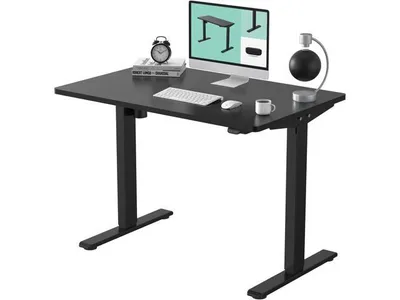
The cheapest honest way to find out electric adjustment is worth it. A single-PC desk that quietly ends the fixed-desk value argument.
The catch: The frame is lighter-duty than the E7 and the 48-inch top really only fits one monitor, so treat it as a single-PC desk rather than a multi-screen battlestation.
More options worth a scroll
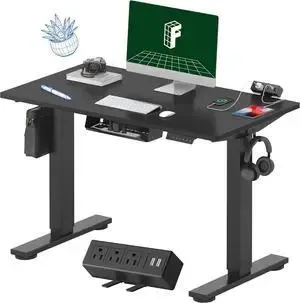
Solid desks that did not make the top three, but fit specific budgets or rooms:
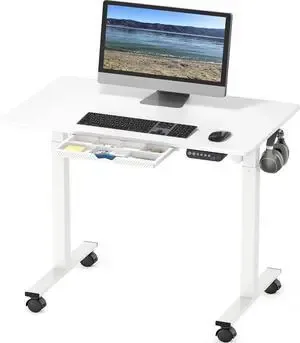
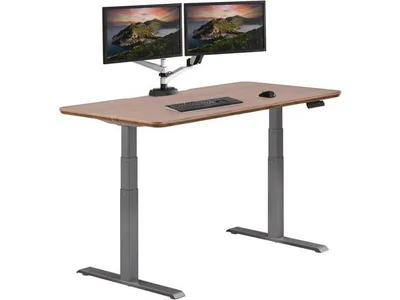
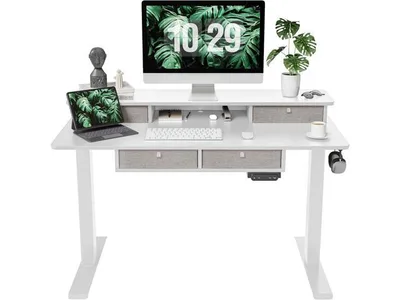
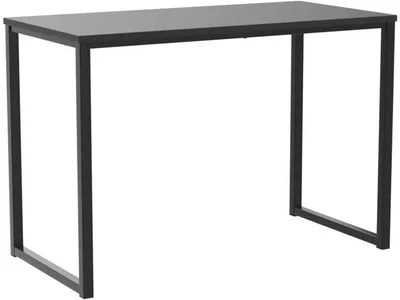
How to choose (and what to skip)
- Dual-motor over single-motor. This is the single biggest quality tell under $300. A single-motor frame drives both legs off one shaft and racks slightly under uneven load, which turns into visible sway at standing height. Dual-motor frames hold steady. If a listing hides the motor count, assume it is single.
- Memory presets are non-negotiable. Without one-touch heights you will stop adjusting within a month, and a standing desk you never raise is just an expensive fixed desk. A keypad with two-plus saved heights is the difference between a habit and a novelty.
- Match size to your monitors. 48 inches wide suits a single screen; 55-60 inches for dual or ultrawide setups. Keep depth at 28-30 inches so big panels sit a healthy distance from your eyes.
- Check stability reviews at your height, not just any height. Every frame feels solid at 28 inches; the cheap ones start to sway at 44. The taller you are, the more the Uplift-grade frame argument wins.
- Skip the no-name bargain frames. A $120 single-motor desk that wobbles is a worse buy than a good fixed desk. Under $150, a simple fixed desk beats a cheap electric one - from our gaming-desk research the Eureka 47-inch (~$170) is the fixed desk we would actually buy. Just measure your elbow height first, because a fixed desk at the wrong height quietly costs you more comfort than any chair upgrade buys back.
- Cables have to move with the desk. An under-desk cable tray mounted to the top keeps the loom clean through the whole travel range.
The bottom line
The office desk worth buying in 2026 is an electric standing desk, and the only real question is how much frame you need. Most people should buy the Flexispot E7 and never think about it again - it is a genuine dual-motor desk at a fair price, and it covers the way normal people actually work. Spring for the Uplift V2 if you are tall, load your desk heavily, or want a decade-scale tool backed by a decade-long warranty. And if you just want to find out whether electric adjustment is worth it without gambling much, the budget Flexispot proves the case for under $250. The one move to avoid is a cheap single-motor frame that sways at height - at that point a good fixed desk at the correct height serves you better. Dial in your sitting height first, add standing as the bonus, and the desk stops being furniture and starts being ergonomics.
Related reading
- The complete ergonomic setup guide - chair, desk, mat and monitor arm matched at three budgets
- Best gaming desks in 2026 - the fixed-desk and gaming-focused picks in full
- Best office chair in 2026 - the other half of the WFH ergonomics system
- Best chair mat in 2026 - floor protection that pairs with a standing desk
Found this useful? Pass it along:
Frequently Asked Questions
What is the best office desk in 2026?
The Uplift V2 (~$599) is the best office desk for most people - the stability benchmark with a 10-year warranty. The Flexispot E7 series delivers most of that quality for $120-200 less, and Flexispot's entry desks around $200 make fixed desks a hard sell at any price.
Is a standing desk actually worth it?
Yes, but not for the reason marketed. The win is not standing all day - it is alternating. Changing position every 30-60 minutes reduces back load, and an electric desk with memory presets removes all friction from doing it. It also lets you dial in the exact correct sitting height, which fixed desks rarely offer.
Uplift vs Flexispot - which standing desk should I buy?
Uplift V2 wins on stability at height, warranty (10 years vs 5) and customization; Flexispot wins on price by $120-200 for comparable sizes. If you are tall, load the desk heavily, or plan to keep it a decade, buy the Uplift. Otherwise the Flexispot E7 line is the value call.
What is the correct desk height?
Sitting: elbows at about 90 degrees with shoulders relaxed - for most people that is 27-29 inches, lower than the 29-30 inch fixed-desk standard. That mismatch is exactly why adjustable desks improve ergonomics even for people who never stand.