RAM and SSD Prices Are Exploding - Buy Now or Wait? (July 2026)
Some links in this guide are affiliate links - we may earn a commission at no extra cost to you.
Memory is the defining story of building a PC in 2026, and it is not a happy one. DDR5 kits cost roughly 4-5x what they did a year ago, mainstream SSDs have doubled, and the analysts who watch contract pricing expect another 40-50% leg up on DRAM before the year is out. If you are building or upgrading in the next six months, the honest advice is uncomfortable and simple: buy the memory and storage now. Nothing on the supply side improves before Q4, so waiting mostly means paying more later.
This is not a rumor cycle. AI datacenters are consuming DRAM and NAND production at a scale the consumer market has never had to compete with, manufacturers make far better margins selling into that demand, and Micron just killed its consumer Crucial memory line entirely. Less consumer supply against steady demand is the whole equation, and it is why the parts that used to be an afterthought in a build are suddenly the line items that hurt.
How we track: we monitor thousands of Newegg listings daily to price the PC builds on this site, and re-verify the kits and drives that matter against live Amazon stock. Every number below is what parts actually sell for this week, not a manufacturer's MSRP fantasy.
The short version: the July window closed. The $200 Samsung 990 Pro deal died (it sits near $390 now), and every 16GB DDR5 kit under $250 sold out without relisting. What is still sane as of mid-September: the Patriot Viper Venom 32GB DDR5-6000 CL30 at about $395 is the cheapest live kit with the spec AM5 actually wants, and the quiet winner of the whole crisis is still DDR4: a Corsair Vengeance LPX 32GB DDR4-3200 kit costs roughly 60% of the DDR5 floor, about $150-165 less, and frees that cash for the GPU. Whatever you pick, buy the memory and storage first - the GPU will still be there next month; today's SSD price probably will not.
The numbers right now
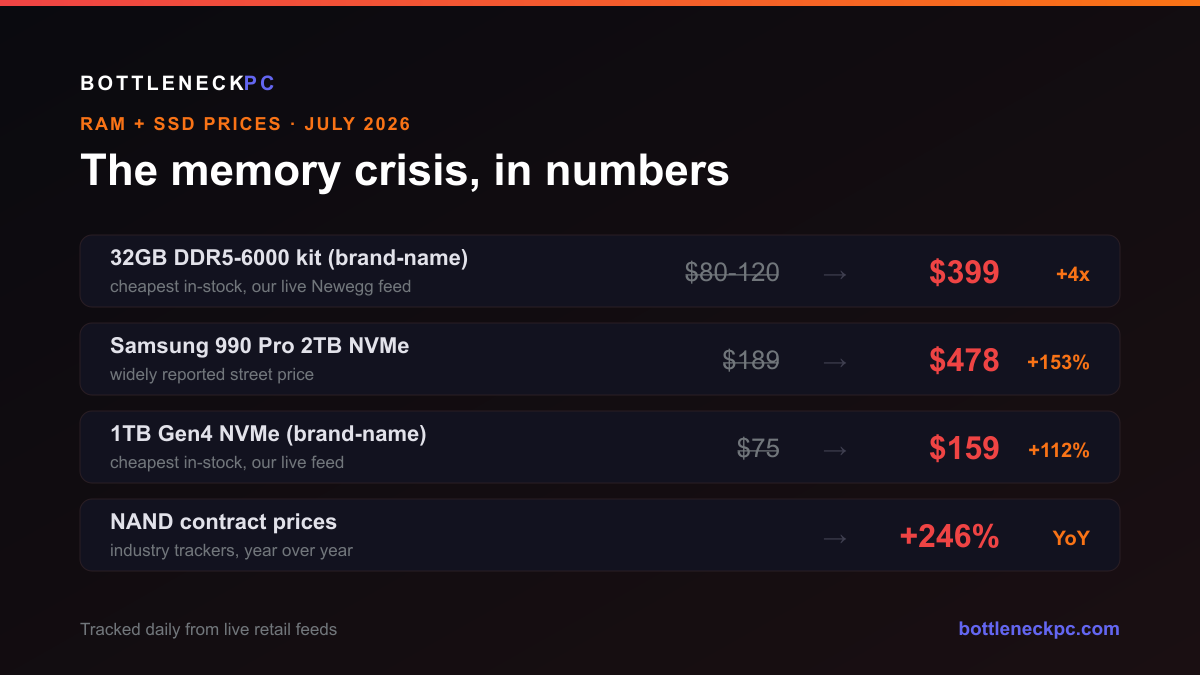
Key numbers - mid-September 2026 (from BottleneckPC's daily price tracking; free to cite with a link to bottleneckpc.com):
- 32GB DDR5: cheapest live kit ~$395 (the Patriot Viper Venom 6000 CL30 - the floor and the good spec are now the same kit); the seven live kits on our tracker run $395-610, median ~$470 - up from $80-120 a year ago (roughly 4-6x)
- 16GB DDR5: no in-stock brand-name kit on our tracker at all now - the last one, a slow-timing ~$250 kit, went dead on September 11, and the sub-$250 kits we tracked in July never relisted
- 64GB DDR5: $736-1,328 across the live kits we track; 96GB sits around $956
- DDR4: 16GB ~$140 (Corsair Vengeance LPX 3200), 32GB $230-250 - still the escape hatch, but no longer immune: faster 16GB kits sit around $210, and a 64GB DDR4 kit runs ~$1,025 at first-party retail
- Samsung 990 Pro 2TB: around $390 on our tracker (the $200 spot deal we flagged in July is dead)
- 1TB Gen4 NVMe: ~$190 (the SanDisk Optimus 5100 is the cheapest live drive we track), up from ~$75
- NAND contract prices: up ~246% year over year, with no relief forecast before Q4
Those are the figures our optimizer had to build the site's parts lists around this month. The $75 1TB SSD we recommended in the spring simply does not exist anymore, and the RAM and storage budget lines moved enough to change which builds make sense at the lower tiers.
What is actually driving this
The internet is calling it RAMageddon, and for once the memes undersell it. The single cause is AI. Datacenter buildouts need enormous quantities of high-bandwidth DRAM and NAND, they need it now, and the vendors who make it would rather sell a wafer into that market than turn it into a $90 consumer kit. When Micron discontinued its consumer Crucial line, it was not a stunt - it was a company reading the margin math and walking away from the least profitable use of scarce capacity.
That is why this feels different from past shortages. It is not a mining bubble or a supply hiccup that clears in a quarter. It is a structural reallocation of the world's memory output toward a buyer with effectively unlimited budget, and consumer builders are simply outbid. Until fab capacity catches up to datacenter appetite, the consumer side gets the leftovers at the leftover price.
The panic wave is new; the numbers mostly are not
Late July added a social phase to the price phase. GamersNexus's "RAM: WTF?" video and its SSD follow-up set off pile-on threads across ResetEra, r/buildapc and r/pcmasterrace, daily "should I buy RAM now" posts, and an "is RAM the new Bitcoin" meme that is funnier than it is wrong. Worth saying plainly: the prices in this post moved a little since the video; the panic moved a lot. Our verdict below was written before the wave and survives it unchanged - buy what a build actually needs, skip the hoard, and treat anyone urging you to "lock in" more memory than your machine uses as part of the problem.
August update: the cheap kits are not repricing - they are disappearing
A month of daily tracking taught us something the price charts alone do not show: in this market, a good price does not go up, it goes away. The kits this post recommended in July - the $220 Viper Elite 5 16GB, the $232 G.Skill Flare X5, the $278 32GB FURY Renegade - are no longer purchasable at those prices at either retailer we check: the listings are out of stock or gone outright, with no relisting, and what remains on the shelf starts $30-130 higher. Storage is the cleanest example because we can name the exact listing: the $199.95 990 Pro heatsink package this post opened with in July now shows $499.95 on the same store, while the bare drive floats around $385-390 everywhere.
That pattern changes the advice in a specific way. "Wait for a dip" assumes prices oscillate. Right now they ratchet: each price tier sells through, delists, and the next-cheapest thing becomes the floor. Our own build generator had to be corrected this week because it was still quoting one of those dead kits at its frozen July price - if a $278 32GB kit looks available anywhere today, check the ship date before you believe it. The deals that still exist are real, but their half-life is days, which is why every price in this post is hedged and every link goes to a live search instead of a stale listing.
Is the crisis ending?
Not on any timeline that helps you this year. Every credible forecast has DDR5 climbing further before year-end, with analysts putting the next move at another 40-50%, and NAND has no relief signal before Q4 either. New fab capacity takes years to come online, so even the optimistic case is a 2027 story, not a summer-2026 one.
The practical read: prices will eventually normalize, because they always do, but "eventually" is far enough out that waiting for it is a bad trade if you actually need the parts. The floor under memory pricing is not cracking in the next two quarters, and every week you wait, the credible expectation is that the number goes up, not down.
The DDR4 escape hatch nobody mentions
Here is the twist that changes real building decisions: the crisis mostly skipped DDR4. A 32GB DDR4-3200 kit runs $230-250 on our tracker, roughly 60% of the DDR5 floor (about $150-165 less), because datacenter demand is chasing the newer memory, not the old stuff. That gap is large enough to reshape a budget build.
Run the math at a fixed total budget and a Ryzen 5000 / AM4 machine with the DDR4 savings redirected into a stronger GPU beats the equivalent DDR5 build on actual gaming performance. Our build generator has been reaching exactly that conclusion at the $750-1,000 tiers all year. The catch is honest and singular: DDR4 platforms are terminal - there is no upgrade path from an AM4 board to a DDR5 chip later. If you do not need that runway, this is the smartest way to dodge the worst of the crisis.
Buy now or wait: the verdict
- Building or upgrading within 6 months - buy now. DDR5 is forecast to climb further before year-end and NAND has no relief signal before Q4. Waiting has negative expected value.
- No build planned - do nothing. Panic-buying RAM you will not use for a year is how you become the meme. Prices will eventually normalize; hardware in a drawer earns nothing.
- On a DDR4 platform (AM4, older Intel) - relax. Your memory is the one thing that barely moved. Stock up only if you actually plan to max the board.
The still-sane picks
Every price below is from our live feed, verified in stock recently. They will not hold, so treat the numbers as a snapshot - the links always show current reality. The logic is consistent across all four: buy the cheapest option that is still a real, brand-name part, because in a crunch the fake savings on a mystery kit or a $75-nostalgia drive that no longer exists cost you more than they save. The storage picks lead because storage is the part most likely to get pricier first, and the 990 Pro deal is the single best value on this page.
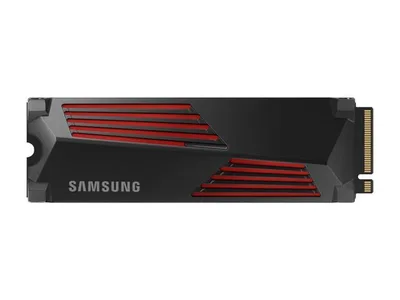
The flagship, repriced
An honest accounting first: the July version of this post led with this drive at $199.95, and readers who moved on it got the flagship Gen4 drive at less than half the market. That listing died within days, our tracker now has the drive near $390, and we are keeping the card here partly as the clearest before-and-after this crisis has produced.
Is it still the pick at $390? If you want the flagship 2TB and intend to keep it for years, yes - it remains the drive every "best SSD" list crowns, and the forecast says $390 ages better than it reads. If $390 is simply too much drive, the budget picks below are the sane alternative, not a cheaper mystery brand.
The catch: We watched this exact drive at $199.95 in July. The window closed in days, and the market never gave it back.
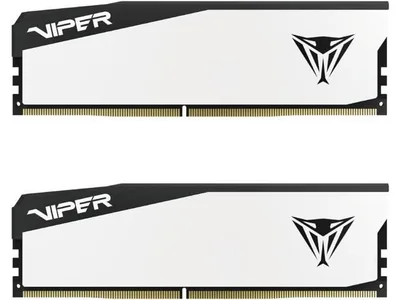
Cheapest sane DDR5
CL30 at 6000MT/s is exactly the sweet spot AMD recommends for AM5, so you are not saving money by dropping to a slower kit that costs your Ryzen chip real performance. One honesty note, still true in mid-September: this exact kit has been playing in-and-out-of-stock games and has no live listing on our tracker as we write, and on our own feed the cheapest live kit at this spec is its sibling, the Patriot Viper Venom 32GB DDR5-6000 CL30 at about $395. Same family, same spec, take whichever is actually in stock.
A year ago this was an $85 kit and I am not over it either. But if the current forecasts land the way analysts expect, today's $395-400 is the price you will wish you had paid. If you are committed to a DDR5 platform, this is the least painful way onto it right now.
The catch: It costs 4x what it should - blame the datacenters, not Patriot. This is the floor for a real kit, not a bargain.
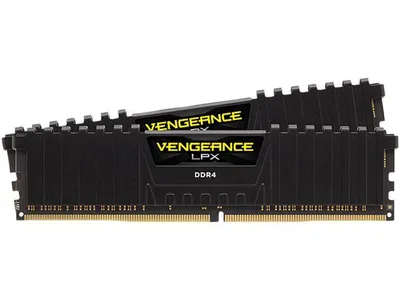
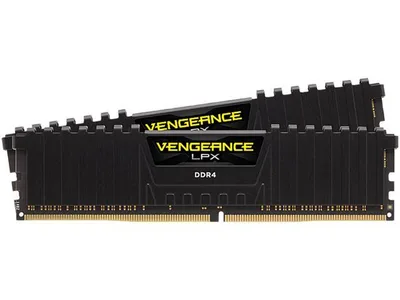
The crisis quietly skipped DDR4, and that changes real building decisions. This proven Corsair kit at ~$250 (the Crucial equivalent is ~$230) runs roughly 60% of the DDR5 floor, which means an AM4 build - Ryzen 5000 still slaps for the money - frees up $150-plus to spend on the GPU instead. At a fixed budget, that redirected cash buys more gaming performance than the DDR5 platform would have.
Our build generator has been reaching this exact conclusion at the budget tiers all year, and I trust the math over brand loyalty here. If you are building cheap and do not need a DDR5 upgrade runway, this is the kit I would grab without a second thought. It is also the most proven set of sticks ever made, which matters when you do not want to gamble during a crunch.
The catch: AM4/LGA1200 platforms only - there is no path from here to a DDR5 board later.
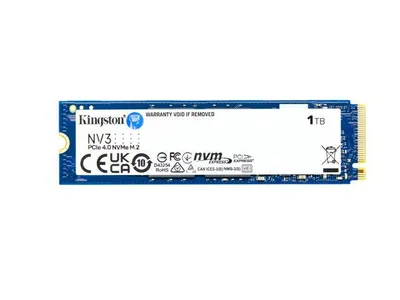
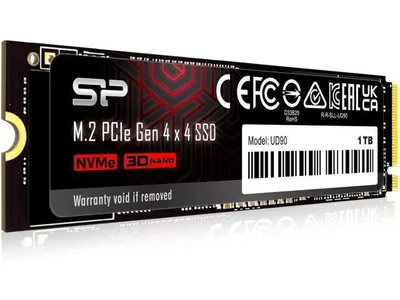
In July this card read "$159, the cheapest brand-name 1TB Gen4 in stock" and warned that the sub-$160 tier would vanish first. It did. Budget 1TB now starts around $190 - on our own feed the cheapest live drive is SanDisk's Optimus 5100 1TB at about $189 - and Kingston itself is telling the press prices keep going up.
The advice survives the reprice: a legitimate boot-and-games drive from a serious brand is still the right budget buy, and the NV3 and its SanDisk equivalent trade the crown week to week. Buy whichever sits lower the day you order, and pair it with a bigger drive when prices calm down.
The catch: DRAM-less, so it is fine for gaming but not for heavy pro workloads - and the sub-$160 version of this tier no longer exists.
More options worth a scroll
What not to do
- Do not buy 128GB "as an investment." You are not a datacenter. Buy what your build uses (32GB gaming, 64GB creator work) and stop.
- Do not buy no-name kits to dodge the prices. A $320 mystery-brand DDR5 kit that fails its memory training saves you nothing. The picks above are the cheapest sane options, which is a different thing than cheapest.
- Do not sell your old DDR4. People are literally dumpster-diving for RAM right now - your old sticks are the most liquid they have ever been, but they are also your fallback if anything fails during the crunch.
The bottom line
We repriced every recommendation on this site this month against live data - storage lines up 60-150%, DDR5 budgets up, and at the $750-1,000 tiers the build generator now leans harder into AM4/DDR4 because the math genuinely flipped. If you are speccing a machine, generate the build first, sanity-check the memory tier with the RAM advisor, and buy the memory and storage pieces first. The verdict for anyone building this year fits in one line: the cheapest day left to buy it is probably today, because every forecast points up from here.
Related reading
- The 2026 RAM shortage explained - the supply-side story behind the prices
- DDR5 prices and when to buy - the deeper dive on memory timing
- Best GPU to buy in 2026 - the other half of the crisis, tier by tier
Found this useful? Pass it along:
Frequently Asked Questions
Should I buy RAM now or wait for prices to drop?
If you are building or upgrading in the next six months, buy now. DDR5 kits are already 3-4x their 2025 prices, memory analysts are forecasting another 40-50% jump before year-end, and manufacturers are shifting production to AI datacenter memory, not consumer kits. There is no relief signal on the supply side before Q4 at the earliest. If you have no build planned, do not panic-buy hardware you will not use.
Why are RAM and SSD prices so high in 2026?
AI datacenter demand is consuming DRAM and NAND production capacity at unprecedented scale, and manufacturers get better margins there than on consumer parts - Micron even discontinued its consumer Crucial memory line. Less consumer supply plus steady demand equals the 4x DDR5 prices and doubled SSD prices we track daily.
How much does 32GB of DDR5 cost right now?
As of mid-September 2026, the cheapest live brand-name 32GB DDR5 kit on our feed is the Patriot Viper Venom DDR5-6000 CL30 at about $395 - the floor and the good spec are now the same kit - and the seven live 32GB kits we track run $395-610, against $80-120 a year ago. DDR4 is the escape hatch: a brand-name 32GB DDR4-3200 kit is $230-250 for AM4 and older Intel platforms, roughly 60% of the DDR5 floor.
Is now a bad time to buy an SSD?
It is a bad time compared to last year and likely a good time compared to what is coming. 1TB Gen4 drives that were $75 now start around $190, and NAND contract prices are up 246% year over year with no relief forecast before Q4. Deals vanish fast and do not return: the Samsung 990 Pro 2TB we caught at $200 in July now sits near $390, and the sub-$160 budget 1TB tier we recommended is gone entirely.
Should I buy DDR4 instead of DDR5 right now?
If you are on a budget, genuinely yes - this is DDR4's moment. A 32GB DDR4 kit runs roughly 60% of the DDR5 floor - about $150-165 less - and a Ryzen 5000/AM4 build with that savings redirected to the GPU outperforms a DDR5 build at the same total budget. Our build generator has been recommending exactly this at the $750-1,000 tiers.