DDR5 RAM Prices in May 2026: Should You Build Now or Wait?
Some links in this guide are affiliate links - we may earn a commission at no extra cost to you.
DDR5 is the single most inflated part in a 2026 PC build. A 32GB kit that sold for around $95 in mid-2024 now runs anywhere from $395 to $570 depending on the brand, and the brief spring dip that had builders hopeful reversed hard through the summer. The AI memory boom is eating the world's DRAM, and it isn't done. So if you're building right now, the only question that matters is a blunt one: do you buy at these prices, or wait for a crash that may not come?
Our answer, up front: if you actually need the PC, buy now with 32GB of DDR5-6000 and stop watching the ticker. The case for that is below, along with what memory really costs this week and what's holding it up there.
How we track: we pull DDR5 kit prices from Newegg, Amazon, and Microcenter daily and re-check the ones that matter against live listings, so the numbers below are what memory actually sells for this week, not a spot-market average or an MSRP that stopped meaning anything two years ago.
Current DDR5 prices, August 2026
These are the kit prices our tracker is seeing this week, across the 32GB, 64GB and 96GB DDR5 kits we currently hold a live price for. Free to cite with a link to bottleneckpc.com.
Rows are grouped by rated speed rather than by CAS latency on purpose. We are re-verifying the timing label on every kit in our catalogue after finding rows whose stated CL does not match the product the listing actually resolves to, and quoting a number we cannot stand behind is worse than omitting it. Speed, capacity and price below are the figures we are confident in.
| Kit | Speed | Price (Aug 2026) | Mid-2024 baseline |
|---|---|---|---|
| 32GB (2x16GB) | DDR5-5600 to 6000 | $390-570 | ~$95 |
| 32GB (2x16GB) | DDR5-6400 | $470-550 | ~$120 |
| 64GB (2x32GB) | DDR5-6000 | $736-1,328 | ~$180 |
| 96GB (2x48GB) | DDR5-5600 | ~$956 | ~$280 |
You're now paying roughly 4 to 6x what these same kits cost in mid-2024, with the 32GB median sitting near $470. The spring pullback reversed through the summer, and memory is back to punishing levels as the DRAM shortage deepened. The gap between brands has become the story: at the same 32GB capacity and the same rated DDR5-6000, we currently track a $395 Patriot Viper Venom and a $570 G.Skill Flare X5. That is a $175 spread for identical speed and capacity, and the premium mostly buys RGB, taller heatspreaders and higher-binned chips. Shop the spread rather than the average, because the average is no longer where anybody actually buys. Check the CAS latency on the listing itself before you commit, since the two kits are not timed the same and the spec is easy to get wrong from a product name alone.
RAM Price Trend: Jul 2025 - Sep 2026
Points through Feb 2026 are market estimates compiled from public reporting. The Sep 26 point is the median kit price in our own live catalogue (32 kits across the three groups), which is weighted toward Amazon listings and is not a claim about the cheapest price available anywhere.
What's actually driving prices
The short version is that AI is eating the world's DRAM. Samsung, SK Hynix, and Micron produce essentially all of it, and all three have shifted serious capacity toward HBM (High Bandwidth Memory) for AI accelerators. Every NVIDIA, Google, Amazon, and Meta training chip needs HBM, and the industry is buying every module that comes off the line.
That squeezes consumer DDR5 from two directions. HBM is built on the same fabs that produce DDR5 dies, so every wafer allocated to HBM is one fewer producing the memory you want. And the DDR5 that does get made is contested: hyperscalers packing out AI servers pay above-spot prices, which drags channel pricing up for everyone underneath them. By late 2025 AI was estimated to consume around 15% of global DRAM output, a figure expected to reach 20% by the end of 2026, while total production capacity grows only about 16% a year. The arithmetic does not favor consumer relief.
Is the shortage ending?
Prices did fall about 20% in spring 2026, so it is fair to ask. But that dip was a cycle effect, not a thaw. After the Q1 spike, channel partners were sitting on inventory bought at high spot prices, demand softened seasonally into a slow quarter for consumer PCs, and some AI infrastructure orders reportedly slipped a quarter as hyperscalers re-evaluated their compute mix. None of that touches the structural problem, and sure enough the discount evaporated through the summer as the underlying DRAM crunch reasserted itself.
The people who make the stuff are saying the quiet part out loud. Micron has publicly suggested oversupply will not return until 2028. Foundry capacity, not trade-show announcements or seasonal demand, is what sets memory pricing, and that capacity is spoken for. The honest read is that DDR5 stays expensive well into 2027 at the earliest, and trying to time the exact bottom is a game you are set up to lose.
DDR4 is not the cheaper escape hatch
The obvious dodge is to build on DDR4 and sidestep the whole mess. It does not work anymore. DDR4 has actually gotten more expensive year over year as production shifts to DDR5 and HBM. The 32GB DDR4-3200 CL16 kits we track now sit at $230, up from around $60 in 2024, so AM4 builders adding memory are paying roughly half of DDR5 money for slower, dead-end RAM. That is a smaller discount than it sounds once you account for the platform being finished.
If you are starting fresh, build on DDR5 with AM5 or LGA1851. The platform costs more up front, but you are buying an upgrade path instead of a cul-de-sac. AM4 in 2026 is a value trap: end-of-life socket, memory that is expensive anyway, and Zen 3 as your ceiling with nothing left to upgrade into.
Buy now or wait?
Build now if you actually need the machine. Waiting to shave $50-150 off a RAM kit costs you real gaming time, productivity, and work capability in the meantime, and that opportunity cost is easy to underweight. If your current PC just died, a new GPU landed, or you are already at a natural upgrade window, the calculus is not close. And if your rig is stuttering or crashing through the games you want to play, do not suffer on principle to win a small bet on prices.
There is also a middle path on AM5: buy a single 16GB stick now, run it, and add a matching stick later when prices ease. We price kits rather than individual sticks, so treat single-stick pricing as roughly half a kit and check it yourself - the cheapest 16GB DDR5 kit we track is $215, which tells you the floor has moved a long way.
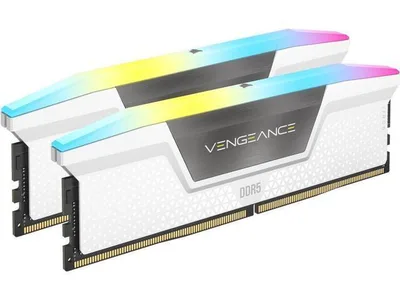
If you buy one kit, buy this class
Corsair Vengeance RGB DDR5-6400 32GB (2x16GB), white
The DDR5-6000 CL36 Vengeance this slot used to name has been unavailable on our feed since 20 July, so it is gone from here rather than left sitting as a link to nothing. This is the same line, a bin up, and actually in stock: DDR5-6400 is past the AM5 sweet spot on paper but costs no more than the 5600 kit right now, which makes the sweet-spot argument moot. Named here as the listing resolves - the RGB white kit - rather than as our catalogue row labelled it, because those two disagreed and the listing is what you actually receive.
Waiting only makes sense if you have a working PC and genuine zero urgency, or you are specifically holding for Zen 6 or Nova Lake late this year, where you will get more platform for your money even if RAM costs about the same. The one move that has reliably lost for two years running is waiting for a crash. That strategy works on cycles measured in months, and this one is measured in years.
How much RAM to buy
At these prices, capacity discipline is where you save real money, so match the kit to what you actually do:
- Pure gaming, or gaming plus light streaming: 32GB DDR5-6000 CL30. Plenty for any current game, and modern OBS streams 1080p60 in well under 4GB. Do not buy 64GB to future-proof right now; the premium is too steep for a benefit you will not see.
- Gaming plus heavy streaming or content creation: 64GB. It hurts, but video rendering, large Photoshop work, and multi-track audio will hit the wall on 32GB.
- Workstation, 3D, or local AI work: 64GB or 96GB regardless of price. If your work depends on it, capacity is not optional.
- Budget builds under $1,000: the single-16GB-now trick above, then add the second stick when the market softens.
The bottom line
DDR5 is expensive, it is staying expensive, and the spring dip that briefly made it look otherwise has already reversed. Do not try to call the bottom. If you need a PC, build it now with 32GB of DDR5-6000 and get on with it. If you have a working machine and no urgency, hold for the late-2026 platform refresh and re-evaluate then. The wait-for-the-crash play has been losing for two years, and nothing in the supply picture suggests the next two are different.
Related reading
- RAM and SSD prices in 2026: buy now or wait? - the full memory-and-storage picture with citable numbers
- RAM shortage 2026: what PC builders need to know - the original analysis of the AI-driven crunch
- DDR6 RAM: everything we know so far - when the next generation actually arrives
Found this useful? Pass it along:
Frequently Asked Questions
How much does 32GB DDR5 cost right now?
The DDR5-6000 32GB kits we track run $395 to $570 as of late August 2026, and the wider 32GB DDR5 field sits around a $470 median. That is roughly 4 to 6x where DDR5 sold in mid-2024 before the AI memory crunch hit, and the spread between the cheapest and dearest kit is now wider than the whole price of a kit two years ago.
Is the DDR5 RAM shortage over?
No. Prices dipped about 20% in spring 2026 but reversed hard through the summer, and 32GB DDR5-6000 now runs $395 to $570. AI demand from hyperscalers is still consuming the marginal DRAM supply, and Micron has publicly suggested oversupply won't return until 2028. Treat the spring dip as a cycle wobble, not a turning point.
Should I build a PC now or wait for RAM prices to drop?
Build now if you need a PC. The downside risk is lower than you think - if RAM drops another $50-100 in six months, that's painful but you've had a working PC the whole time. The upside risk of waiting is higher - if AI demand surges again, prices could spike back to their Q1 2026 highs. Waiting it out has cost a lot of builders a lot of gaming time over the past two years.
Is DDR4 cheaper than DDR5 right now?
Surprisingly, often not. DDR4 has been getting more expensive as production capacity shifts to DDR5 and HBM. AM4 builders trying to add DDR4 RAM in 2026 are sometimes paying nearly DDR5 prices for inferior memory. If you're starting fresh, DDR5 on AM5 or LGA1851 is the smarter platform choice now.
What's the best DDR5 speed to buy for AM5?
DDR5-6000 CL30 is the sweet spot for AM5. Faster kits (DDR5-6400, DDR5-7200) cost dramatically more and deliver minimal real-world gains because AMD's memory controller tops out around 6000-6400 MT/s for stable 1:1 mode. Don't pay extra for fast kits unless you're chasing benchmark numbers.
When will DDR5 prices actually come down?
Not soon. Memory pricing is driven by foundry capacity allocation, and the fabs are prioritizing HBM for AI accelerators. The earliest realistic timeline for meaningful relief is mid-to-late 2027, and most analysts, Micron included, point to 2028 before pricing normalizes.