Motherboards Are the Only Cheap Part Left in 2026 - and Nobody Is Talking About It
Some links in this guide are affiliate links - we may earn a commission at no extra cost to you.
Every PC builder feels it: the parts list that cost $1,500 two years ago quietly became $2,100. RAM tripled. GPUs start at real money and end at absurd money. Even used cards are holding value like blue-chip stocks.
Except one line item went the other way, and almost nobody is saying it out loud: motherboards are the cheapest they have been in years.
We track prices daily across every part category on this site, so here is the receipts version.
The numbers, from our own tracker
On the memory side: the cheapest sweet-spot 32GB DDR5 kit in our catalog today runs about $395 - money that bought a premium 64GB kit before the shortage. The 64GB kits people buy for productivity builds have crossed $1,000: our tracker shows a Kingston Fury Beast 64GB DDR5 kit at $1,327.99, first-party, in stock, and its DDR4 sibling at $1,024.99 - four figures for memory tech from 2014. We have been documenting the climb since it started.
GPUs: the cheapest current-gen card we would actually recommend, the RX 9060 XT 16GB, runs about $520. The RTX 5080 sits around $1,250 at the cheapest retailer. The flagship, where you can find one at all, is north of $6,500.
Now the boards, from our live catalog this week:
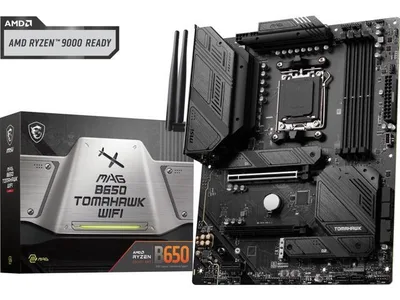
- MSI MAG B650 Tomahawk WiFi - the most-recommended AM5 board of this generation - is ~$172, down from the $220-240 it held for most of its life.
- Gigabyte B650 Aorus Elite AX - the classic beginner pick - is ~$140 on clearance as B650 winds down.
- MSI MAG X870 Tomahawk WiFi - dual USB4, Wi-Fi 7, four M.2, a 14+2+1 VRM - launched at a $299 MSRP and sells for ~$230.
- ASRock X870E Taichi - a flagship-class E-ATX board Tom's Hardware gave an Editor's Choice - launched at $499 and our tracker has it at ~$350.
- On Intel, the MAG Z890 Tomahawk with dual Thunderbolt 4 and Wi-Fi 7 is ~$230, and the Z890 Taichi Lite undercuts every comparable premium board at $399.
A flagship-adjacent motherboard now costs about a third of a mid-tier GPU. The most-recommended board on the platform costs less than the RAM you will put in it. That sentence would have been nonsense in any previous build cycle.
Why this happened
Three forces stacked on top of each other:
1. The shortage is in DRAM, and boards do not use it. The memory crunch driving RAM and SSD prices is a DRAM and NAND supply story. A motherboard is a PCB, power stages, and controllers - none of it competes for the wafers everyone is fighting over. Board costs never spiked, so board prices reflect demand, not scarcity.
2. Demand cratered while supply matured. When RAM and GPUs eat the whole budget, fewer people green-light full builds - and every unbuilt PC is an unsold motherboard. Meanwhile AM5 is three CPU generations deep with hundreds of competing SKUs, and the B850/B860 midrange launched into that crowd. Oversupply plus soft demand is how you get a $299 MSRP board at $230 within months.
3. Last-gen clearance. B650 is discontinued and Z790 is winding down, so retailers are flushing stock at prices that drag the whole category down. A $140 B650 Aorus Elite makes a $260 midrange board look silly, and pricing pressure rolls uphill.
How to actually exploit it
The move is not "buy the cheapest board." The move is stop overpaying for the one component that got cheap, and redirect every saved dollar to the components that got expensive - starting with RAM, because it is still climbing.
Concretely:
- Gaming build, no exotic needs: spend $170-230. The X870 Tomahawk (AMD) and Z890 Tomahawk (Intel) are the shape of right. A more expensive board adds zero FPS - the board has never been the bottleneck, and you can prove that for your exact CPU and GPU.
- Want premium I/O for cheap: this is the window. Boards with dual USB4, 12+ rear ports, and flagship VRMs are selling at midrange prices - the X870E Taichi at ~$350 is the loudest example.
- Redirect the savings to RAM first. A board that saves you $100 pays for most of the gap between a 16GB afterthought and a proper 32GB sweet-spot kit - and unlike the GPU market, RAM pricing is still moving against you. Buy the memory before it costs more, then put the rest into the GPU tier.
- On a hard budget: B650 clearance is the best price-to-platform deal in PC building right now, but it is literal clearance - when the $140 boards are gone, they are gone.
We just launched a motherboard section with full spec sheets, attributed review roundups, live prices, and complete build-around recommendations for the boards we would actually buy - every board above has a page. It is the cheap part of your build; we made it the easy part too.
Found this useful? Pass it along:
Frequently Asked Questions
Why are motherboards so cheap in 2026?
Three forces stacked: AM5 boards matured into heavy competition (B850 midrange launched into a crowded market), last-gen chipsets like B650 and Z790 hit clearance as they were discontinued, and full-build demand softened because RAM and GPU prices exploded - leaving boards oversupplied. Motherboards also do not use the DRAM that is actually in shortage, so their costs never spiked.
How much should I spend on a motherboard in 2026?
For most gaming builds: $170-230 buys a board with a strong VRM, Wi-Fi, and modern I/O - the MSI Tomahawk boards and Gigabyte Aorus Elite tier live here. Premium features like dual USB4, 10 GbE, or six M.2 slots run $350-400. Past that you are paying for halo features most builds never touch.
Should I put motherboard savings into RAM or the GPU?
RAM first, and early. DDR5 pricing has been climbing for months - a sweet-spot 32GB kit runs close to $395 today and 64GB kits have crossed $1,000, with first-party listings on our tracker at ~$1,328. The GPU market is expensive but stable; the RAM market is expensive and still moving. Lock the RAM, then put what is left into the GPU tier.
Is a cheap motherboard bad for gaming performance?
No. The motherboard does not add frames - the CPU/GPU pairing does. A $210 board runs a 9800X3D at the same FPS as a $1,300 board. Boards differ in connectivity, VRM headroom for overclocking, storage slots, and build convenience - not gaming speed. Check any pairing in our free bottleneck calculator.