Prebuilt vs Building a PC in 2026: The Math Flipped and We Can Prove It
Some links in this guide are affiliate links - we may earn a commission at no extra cost to you.
There's a Reddit thread this week accusing a streamer-branded system integrator of price gouging - an i3 with a GTX 1660 Ti at a thousand dollars - and the replies are full of people discovering, mid-argument, an uncomfortable fact: several of the machines they checked were cheaper than the parts.
Both things are true at once, and that's why the argument never resolves. So let's do what nobody in those threads can: put a live parts-price tracker and a live prebuilt dataset next to each other and read the numbers off.
The claim, stated precisely
For twenty years, "build it yourself and save money" was reliable enough to be an identity. In 2026, below roughly $1,500, it is frequently false. Above $2,000 it's still mostly true. The zone between is a coin flip that depends on the specific machine.
We don't say that lightly - this site exists to help people build. But we track every part price daily and we track 145 in-stock prebuilt machines across 35 graphics cards, and the honest reading of our own data is the reading above.
What our numbers actually show
Some figures from the datasets as we write this, all moving targets:
The build side. Our own couch-PC guide prices a 1080p parts list at about $1,060 - and admits in the same breath that Valve sells a comparable machine for $1,049. The single line item that did this: a 16GB memory kit that cost about $80 two years ago is $220 now, and even bargain-bin DDR4 sticks in our catalog start at $87. Storage followed - the cheap 2TB drives we track sit around $245-255, roughly double their 2024 tags.
The buy side. The 145 machines we track have a median price of about $1,579, and 41 of them - nearly a third - are under $1,000. The cheapest current-generation machine in the set is a $949 Arc B580 tower, a card our score puts comfortably in 1440p territory. Try assembling a current-gen 1440p box for $949 at retail memory prices; we'll wait.
The proof you can poke. Our build generator shows matching in-stock prebuilts next to every parts list it produces, with the delta printed on each one. As we write, a $1,500 NVIDIA build shows machines beside it at $204 to $304 less than building - with the same GPU. That badge isn't marketing; it's subtraction.
Parts list vs prebuilt at three budgets (our tracker, this week)
Below $1,500 the buy column keeps winning or tying; at $2,400 the same comparison flips $400 the other way. Neither side of the old argument survives contact with both rows.
Why this happened
Not because assembly got cheap or because integrators got generous. The RAM crisis flipped the sign.
System integrators buy memory, storage, and power supplies on volume contracts, and many locked pricing before the shortage repriced the spot market. You buy at whatever this week's retail is. When components were cheap, that difference was smaller than the integrator's margin, so DIY won. In 2026 the difference on memory alone can exceed what the builder charges for assembly, warranty, and Windows combined. The market's structure didn't change; one input's price did, and it happened to be the input you can least avoid.
Where building still wins, clearly
Being the honest broker cuts both ways, so:
Above ~$2,000. The GPU dominates the bill, memory shrinks as a share, and prebuilt pricing at the high end drifts toward what the market will bear. Our dataset's upper half contains some genuinely poor value.
The parts you can't see. A listing states its GPU accurately because the GPU sells the machine. The power supply, the motherboard's VRMs, the case airflow, whether that "16GB DDR4" is one stick - the price advantage frequently lives in those lines. This is precisely the thread-starter accusation against the streamer-branded builders: not that every machine is overpriced, but that the ones that aren't cheap are quietly built down. We can't audit closed boxes, which is why every prebuilt card on this site lists only what the seller's own listing states - and why our tiles show RAM and storage only when the listing names them. A missing spec row is itself information.
The long game. A self-built machine is a platform: you know every part, every part has a retail warranty, and the upgrade path is yours. That's worth real money. It's just no longer worth any amount of money, which is what the old advice quietly assumed.
A worked example, so this isn't hand-waving
Take that $949 Arc B580 machine, the cheapest current-generation unit in our dataset, and try to build it at this week's retail prices. The card alone runs about $300. A 16GB DDR5 kit is $220 in the shortage market. A 1TB drive around $150. Before you've bought a CPU, motherboard, power supply, case, or Windows license, you've spent $670 of your $949 - and those five remaining items cannot be bought decently for $279. A sane self-build of that machine lands somewhere between $1,050 and $1,150. The prebuilt is not cheaper because someone is being kind; it's cheaper because its builder bought that RAM and SSD months ago at prices that no longer exist.
Now flip it: the same dataset's upper floors hold $2,400 machines whose visible parts price out near $2,000 retail even at crisis prices. Same market, same week, opposite verdict. Which is the entire point - "prebuilt vs DIY" stopped having a single answer, so the useful skill is pricing the specific machine, not memorizing a rule from 2019.
Two machines from the dataset make the point concrete - the same listings the numbers above describe, prices approximate and stock genuinely thin:
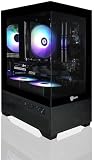
The $949 machine from the worked example
AVGPC Arc B580 tower - i5-11400F, Arc B580
The cheapest current-generation prebuilt in our tracked set, and the machine you just watched fail to be self-built for under $1,050. The CPU is older - that's part of how the price happened - but the B580 does the gaming work.
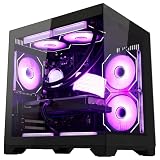
The $1,500-class test case
HELLOLAND RTX 5070 tower - Ryzen 7 5700X, RTX 5070
A $1,560 machine sitting almost exactly on our generator's ~$1,500 parts total for a 5070 build - the crossover zone, where neither side wins by default. That makes it the perfect practice target for the two-minute check: the price won't decide for you, so the spec rows have to.
When the delta badge lies to you
Our build tool's "$X less than building" badge is subtraction against a full parts list at that budget, and it's honest as far as it goes. Three ways to misread it: the delta says nothing about the parts the listing omits, so a big green number next to an unstated power supply deserves suspicion, not celebration. It compares against building new - if you're a used-market shopper, the secondhand route can beat both sides. And a marketplace seller's prebuilt carries a marketplace seller's warranty, which is not the retail warranty a self-build gets on every component. The badge starts the analysis; the spec rows finish it.
The two-minute check that settles any specific machine
Skip the forum argument entirely:
- Put the machine's GPU into the build generator at the machine's price. It will assemble the best self-build at that money and show the prebuilt delta right beside it.
- Run the listed CPU and GPU through the bottleneck calculator - the cheap-machine trick of a current GPU behind a three-generation-old CPU shows up instantly.
- Check what the listing doesn't say. No PSU wattage, no motherboard model, no RAM speed? Priced accordingly.
Or start from the other side: browse the full prebuilt set filtered by GPU, budget, and builder, with each machine tagged by the resolution our scores say its card can actually hold.
The bottom line
The old rule was "build unless you have a reason not to." The 2026 rule is narrower and more useful: under $1,500, check before you assume building wins, because it often doesn't anymore; over $2,000, build unless you specifically value the warranty; in between, run the two-minute check. The people angriest about this flip are the ones whose identity was the old rule. The people quietly benefiting are the ones reading deltas instead of doctrine.
Found this useful? Pass it along:
Frequently Asked Questions
Is it cheaper to buy a prebuilt or build a PC in 2026?
Below about $1,500, buying frequently wins now - a reversal of twenty years of PC-building advice. System integrators buy memory and storage at contract prices negotiated before the 2026 shortage repriced everything, so their machines carry parts at costs a retail shopper cannot get. Above $2,000 the advantage fades and building regains its usual edge in part quality and upgrade path.
Why are prebuilts suddenly cheaper than building?
The RAM crisis, mostly. Memory that cost about $80 two years ago runs $200-370 retail today, and SSDs followed. Big builders locked volume pricing before the spike, so the gap between what they pay and what you pay at retail became, for the first time, bigger than their assembly margin. When components were cheap, DIY always won; the shortage inverted it.
What's the catch with cheap prebuilts?
The parts the listing does not name. The GPU is stated accurately because it sells the machine; the power supply, motherboard and case are where a low price gets manufactured. A machine that undercuts self-building by $300 usually found that money somewhere, and you should want to know where before you buy.
How do I check if a specific prebuilt is a good deal?
Compare it against a self-build with the same graphics card at the same total. Our build generator prices a full parts list from live data and shows matching in-stock prebuilts next to it with the exact dollar difference, and the bottleneck calculator will tell you whether the listed CPU actually matches the GPU. Two minutes, no spreadsheet.