The Best Gaming TVs in 2026: 165Hz Came to the Living Room
Some links in this guide are affiliate links - we may earn a commission at no extra cost to you.
TVs used to be where gaming performance went to die - 60Hz panels, hidden input lag, motion soap-opera modes you had to dig through menus to kill. The 2026 living room looks nothing like that. The headline change: 165Hz native refresh has arrived on mainstream mini-LED sets, VRR windows run 48-165Hz, and game modes are one button instead of a settings safari.
What separates a real gaming TV from a TV with a "game" sticker: a high-refresh panel with VRR (the tear-killer), auto low-latency that actually engages, full-bandwidth HDMI 2.1 ports in useful quantity, and enough brightness for the room you actually play in - the spec nobody weighs until the afternoon sun washes out their dark-and-moody RPG.
How we rank: the review labs' measurements (input lag, VRR behavior, brightness) plus the feature set that survives real use, priced at street. We aggregate published testing rather than running a panel lab, and TV prices swing hard week to week - treat every number here as "about."
The short version
For the living room most people actually have - windows, lamps, daytime sessions - the Hisense U8QG is the pick: a 165Hz mini-LED that gets punishingly bright and carries the full gaming feature set. In a dim room with more budget, the LG C5 OLED is the measuring stick everything else gets compared to. On a tighter budget, the Hisense U7 series keeps the same 165Hz gaming DNA for hundreds less.
The bright-room flagship
The U8QG is the set that made 165Hz a living-room number instead of a monitor number. The mini-LED backlight pushes brightness no OLED approaches - Hisense rates the panel's peaks in thousands of nits - which means HDR that still looks like HDR at 2 PM, and the gaming stack is complete: VRR across the full refresh range, auto low-latency, and a Game Bar overlay for settings without leaving the match. The review labs consistently rank it the strongest set Hisense makes, and the street price undercuts the big-brand flagships it competes with.
The honest tradeoffs are the mini-LED usuals. Viewing angles fade off-axis compared to OLED, so a wide couch arrangement waters down the picture for the person on the end seat. And per-pixel contrast is still physics OLED wins - dark-room cinephiles will spot the blooming a backlight cannot fully hide. For the sunlit, controller-in-hand living room this page is about, neither dents the verdict.
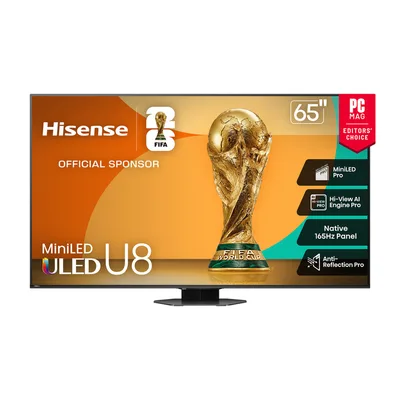
165Hz, VRR, and daylight-proof brightness at a price the badge brands will not touch. The gaming TV for rooms with windows.
The catch: Mini-LED physics: off-axis seats and pitch-dark rooms give up ground to OLED - this set is built for the bright, busy living room.
The reference everyone measures against
The LG C-series is what "gaming TV" reviews benchmark, and the C5 keeps the crown honest: four full-bandwidth HDMI 2.1 ports, 144Hz with every VRR flavor, and the near-instant pixel response that makes OLED motion look sorted in a way no backlit panel replicates. Input lag measures low enough that the TV stops being part of the conversation. If your gaming skews dark rooms, story-driven single players, and film nights, this is where the money goes.
Two things earn the caveat line. Brightness: excellent for OLED and still not mini-LED daylight-proof, so match it to the room. And the burn-in conversation: modern panels plus built-in care cycles have made it a non-issue for varied use, but if your screen shows the same static HUD ten hours a day, every day, the mini-LED above removes the thought entirely.
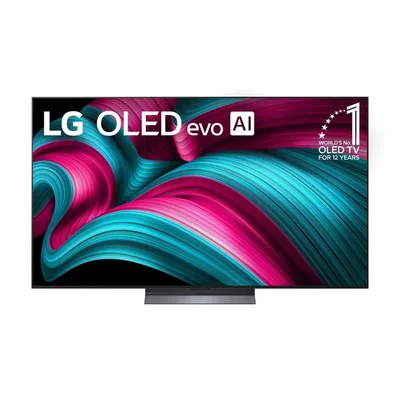
The set the others get measured against: per-pixel contrast, instant response, four full HDMI 2.1 ports. Dim-room royalty.
The catch: Room-dependent: OLED brightness is fine until the sun disagrees, and all-day static-HUD grinders may prefer mini-LED peace of mind.
The same DNA for hundreds less
Hisense's U7 series is the quiet value play: the same 165Hz Game Mode Ultra as the flagship, VRR from 48 to 165Hz, FreeSync Premium Pro, auto low-latency, and the same Game Bar - on a mini-LED panel rated to 3,000-nit peaks. That is the entire gaming feature set of TVs twice its price, minus brightness headroom and some backlight finesse. At the typical street price around $800 for the 65-inch, it is the pick when the room needs a bigger screen more than it needs the last word in panel quality.
What you give up against the U8QG is mostly picture polish: fewer dimming zones means more visible blooming, and the peak-brightness gap shows in demanding HDR. The gaming experience - the part measured in milliseconds and tearing - is functionally the flagship's. That is exactly the corner to cut.
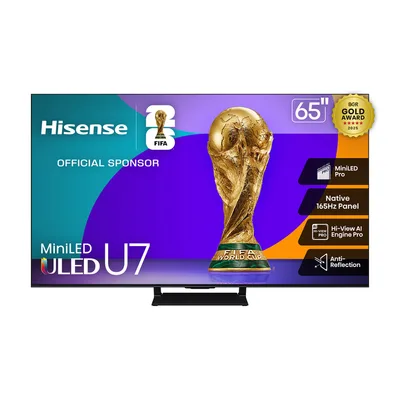
The flagship's entire 165Hz gaming stack at a value price. Proof the good corner to cut is picture polish, not input lag.
The catch: The picture-polish gap vs the U8QG is real in HDR - the gaming feature set is not where they differ.
Worth a cross-shop
TCL's QM8-series mini-LEDs are the U8QG's most direct rival - comparably bright, aggressively priced, and worth a price check on Amazon the week you buy, because these two brands undercut each other constantly. And if the screen is going in a dedicated dim room at 100 inches instead of 65, that budget shops differently - see the gaming projector guide, where the same money buys triple the diagonal.
The bottom line
Buy the room, then the panel. Sunlit shared living room: the U8QG's brightness and 165Hz stack is the complete answer. Dim room, film taste, deeper budget: the C5 is the reference for a reason. Budget first: the U7 keeps every millisecond that matters and cuts only polish. Whichever way you go, plug the console or PC into a real HDMI 2.1 port, flip game mode on, and check that your hardware can actually feed 4K at high refresh - a 165Hz panel showing 60 GPU-bound frames is the living-room version of buying speed you cannot see.
Related reading
- The best gaming projectors in 2026 - when the wall beats the panel
- The best 1440p gaming monitor in 2026 - the desk-distance answer
- Power cost calculator - what a 65-inch panel adds to the bill next to your PC
- Free bottleneck checker - confirm the frames before buying the hertz
Found this useful? Pass it along:
Frequently Asked Questions
What is the best TV for gaming in 2026?
For most living rooms, the Hisense U8QG: a 165Hz mini-LED bright enough for daytime play with the full VRR and low-latency feature set. If your room is dim and your budget stretches, the LG C5 OLED is the reference - per-pixel contrast and near-instant response nothing backlit can match.
Is OLED or mini-LED better for gaming?
OLED wins response time and contrast; mini-LED wins brightness and burn-in immunity. The honest split: dim or evening-lit rooms favor OLED, sun-flooded rooms favor mini-LED, and grinders who park a static HUD on screen twelve hours a day have one less thing to think about on mini-LED.
Can I use a gaming TV as a PC monitor?
Yes, and 2026 sets are genuinely good at it - 165Hz panels, VRR, and auto low-latency over HDMI 2.1. Check two things: text clarity at your viewing distance (4K at 55-65 inches is comfortable from about 3 feet) and that you are plugged into a full-bandwidth HDMI 2.1 port. Confirm your GPU can actually feed 4K at high refresh with our bottleneck checker first.
Does HDMI 2.1 matter for gaming TVs?
It is the whole ballgame: 4K at 120Hz+ with VRR needs HDMI 2.1 bandwidth. Every TV on this page has it, but port counts differ - if you connect a PC, a PS5, and an Xbox, count the full-speed ports before buying, because on some sets only two of the four run at full bandwidth.