The $799 Xbox: The Memory Crisis Just Repriced the Console Era
Some links in this guide are affiliate links - we may earn a commission at no extra cost to you.
The Xbox Series X is now a $799.99 console, the Series S a $499.99 one, and the fifteen-month scoreboard reads: three price increases, zero price cuts, one discontinued storage tier. Treating this as one more dated headline undersells what happened. A price floor moved, it moved for a reason that is getting worse, and the reason is one this site measures every morning.
Microsoft told you exactly why, and our data agrees
The announcement blames storage and memory costs, which Microsoft says have risen more than 2.5x on AI datacenter demand - and which it expects to roughly double again by fall 2027.
That claim gets no argument from our side of the fence. We price-check name-brand RAM kits daily, and retail memory sits at roughly 4x its 2024 level; SSDs roughly doubled. A console is, in bill-of-materials terms, a memory-and-storage product wrapped around a mid-range GPU - and reports put Microsoft losing around $150 per console even at the new price. Read those two facts together and the conclusion writes itself: this hike is not opportunism to be waited out. A company losing money at $799 does not discount later, and an input it publicly expects to double is not an input it eats forever. The uncomfortable arithmetic is that hike number four has a stated cause on a stated timeline, and the cause is Microsoft's own forecast.
The moat is now $150 wide
For twenty years the console argument compressed to one sentence: it is the cheap, predictable box. Here is what predictable looks like now, against our live prebuilt tracker:
At $649.99, the Series X undercut the cheapest current-generation gaming PC we track by about $300. At $799.99, the gap is $150 - the price of two full-priced Xbox games. Our tracker holds 145 in-stock gaming desktops: median $1,579, 41 of them under $1,000, and the cheapest current-generation machine a $949 Arc B580 tower our scores rate comfortably into 1440p.
$150 is the entire moat, and it is the kind of moat that pays for itself in reverse: cross it once and online multiplayer stops costing $80 a year, one storefront's prices become five storefronts competing, and the next hardware generation is a part swap instead of a new box. We ran the full total-cost math in the console-vs-PC breakdown; the purchase price was always the console's best argument, and every hike shrinks it.
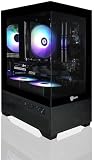
What $150 over the Xbox price buys
AVGPC Arc B580 Gaming Tower - i5-11400F, 16GB
The cheapest current-generation machine in our tracked set, and the unit that defines the new gap. Older CPU - that is the corner that was cut - but a real 1440p-capable GPU, free online forever, and a Steam library that never resets when a generation ends.
Or work it from your own budget: the build generator prices a full parts list with live data and shows in-stock prebuilts beside it, and the prebuilt browser filters all 145 machines by GPU and budget.
Six years of the same box, at four different prices
Xbox Series X and S, launch price to today
Neither machine changed. The Series X shipped in November 2020 and the silicon inside it is the same silicon today - what moved is what that silicon costs to buy.
This is the part worth sitting with. Console generations have always run the other direction: launch high, drift down, land cheap by the time the library is deep. The Series X spent its first four years doing exactly that, then reversed. Nothing about the machine improved to justify it. A buyer in 2026 pays 60% more than a launch-day buyer did for hardware that is now six years old, with a shorter runway of support in front of it.
That inversion is the real story, and it is not an Xbox story. The PS5 sits at $649 after its own hike, the PS5 Pro at $899, and Valve's Steam Machine arrived at $1,049. Every box in the living room moved the same direction in the same year, because they all buy memory from the same squeezed market. When four competitors raise prices together and none of them is winning share by holding the line, that is not a pricing strategy - it is a cost floor.
What $799 buys in hardware terms
Set the brand aside and the Series X is a fixed 2020 parts list: an eight-core Zen 2 CPU, 16GB of shared memory, and a GPU that on our 0-100 gaming scale lands in the same neighborhood as an RX 6700 or an Arc B580 - cards that score around 49 and 50 respectively. Both of those sit near the bottom of what we would recommend for a new 1440p build today.
None of that makes the Series X a bad machine. Console optimization is real, developers target that exact spec, and games look better on it than the raw numbers suggest. But at $499 in 2020 it was a genuine hardware bargain, and at $799 in 2026 the bargain is gone: you are paying a 2026 price for 2020 silicon, and the compensation is convenience and Game Pass rather than performance. That is a legitimate thing to buy. It is just a different purchase than the one the console pitch has been making for twenty years.
Who the new floor actually squeezes
Not current owners - a working Series X costs its owner nothing extra, and rising floors quietly lift what the box under your TV is worth (the used price checker will tell you). Not PC owners either.
The squeeze lands on first-time buyers and the holiday-gift market, and the Series S tells that story better than the X: $299 two years ago, $499.99 now. The "budget console" - the machine whose entire identity was being the affordable on-ramp to gaming - has gained two hundred dollars in two years while its hardware stayed identical. Our opinion, plainly: the console era's defining promise was the cheap, predictable box, and that promise is now broken at every price point. A market where the budget option costs $500 and a real PC costs $949 is a different argument than the one console buyers spent twenty years winning.
And if you price all of it and still want the Xbox - Game Pass is genuinely the best subscription deal in gaming, and an existing controller-and-friends ecosystem is worth real money - buy it with eyes open: you are paying $799.99 for the box and the stated trajectory of its most volatile input is up.
The bottom line
The $799 Xbox is not an outrage story; it is a measurement. Memory repriced the whole industry - our RAM tracker, GPU board partners, SSDs, and now the living room box all read from the same supply chain - and Microsoft's own forecast says the pressure roughly doubles by fall 2027. So make the decision the measurement supports: if the console ecosystem is where your value lives, the price is the price and waiting for relief contradicts the vendor's own guidance. If the $150 gap makes you hesitate, that hesitation is your answer - price the PC while the gap is this small, because on current course the next move in this story is not a discount.
Related reading
- Console prices vs building a PC in 2026 - the full total-cost math
- Prebuilt vs building a PC - why the under-$1,500 market flipped
- RAM and SSD prices: buy now or wait? - the input cost doing all of this
Found this useful? Pass it along:
Frequently Asked Questions
How much does an Xbox Series X cost now?
$799.99 as of August 1, 2026, up from $649.99. The Series S is $499.99, up from $399.99. It is the third Xbox price increase in roughly fifteen months, and the 2TB Galaxy Black edition was discontinued in the same announcement.
Why do Xbox prices keep going up?
Microsoft points at storage and memory costs, which it says have risen more than 2.5x on AI datacenter demand - the same shortage driving RAM and SSD prices for PC builders, which our tracker confirms daily. Reports indicate Microsoft loses money on each console even at the new price, which is why hikes stick instead of reversing.
Will Xbox prices go up again?
Microsoft itself expects memory costs to roughly double again by fall 2027. Nobody announces a price increase they have not decided on, but the input its last two hikes were blamed on is forecast - by Microsoft - to get worse. Planning around a stable $799 for the long term is optimism the company's own statements do not support.
Is a gaming PC cheaper than the new Xbox price?
The gap has never been thinner. At $799.99, the Series X sits $150 under the cheapest current-generation gaming PC we track (a $949 Arc B580 tower), and 41 of the 145 prebuilts on our tracker cost less than $1,000 - with free online play and cheaper games narrowing the total-cost gap further every year you own the machine.