16GB Is the New 32GB: Why We Changed Our RAM Advice for 2026 Builds
Some links in this guide are affiliate links - we may earn a commission at no extra cost to you.
In June we wrote that 32GB of RAM was the sweet spot for a gaming PC and that 16GB was something you would "feel in newer titles." That was true then and it is still true in a narrow sense: 32GB is better than 16GB. What changed is the price of the difference.
On November 10, 2026, the cheapest good 16GB DDR5-6000 kit on Amazon was $249.99 and the same kit in 32GB was $489.99. That is a $240 upgrade, and it buys you nothing in most games. In 2025, before the AI memory shortage, the whole 32GB kit cost around $100, and when a sweet spot costs $100 you do not argue about it. When it costs $240 on top of an already-expensive build, you should ask what else that money could do. For most people building a gaming PC this winter, the answer is a better graphics card, and that turns out to be the thing that makes 16GB work.
Where 16GB actually fails
When a game stutters on a 16GB PC, it is tempting to blame the RAM. Often the real culprit is the graphics card.
A modern game wants to keep its textures in VRAM, the memory on the graphics card. When the card runs out, the overflow goes into system RAM over the PCIe bus, which is far slower. That spillover is what turns a comfortable 16GB system into a full one. TechSpot's 2026 RAM testing showed it with Spider-Man 2 on an 8GB card: assets that did not fit in VRAM pushed total system memory use to about 23GB. On a card with enough VRAM, the same game sits comfortably inside 16GB. The same tests found Marvel Rivals and Black Myth: Wukong running about the same on 16GB and 32GB.
So the failing setup is 16GB of RAM plus an 8GB graphics card. Each one makes the other worse. Fix the card and 16GB stops being the bottleneck in most games.
The $240 question
The trade at real prices looks like this. Both cards are sold by Amazon itself, both RAM kits by Patriot's own store, all read on November 10, 2026.
| Build choice | RAM | Graphics card | RAM + GPU total |
|---|---|---|---|
| 32GB RAM, 8GB card | Viper Venom 32GB DDR5-6000, $489.99 | ASUS Prime RTX 5060 8GB, $534.99 | $1,024.98 |
| 16GB RAM, 16GB card | Viper Venom 16GB DDR5-6000, $249.99 | ASUS Prime RTX 5060 Ti 16GB, $829.99 | $1,079.98 |
For $55 more, the second build has twice the video memory and a faster GPU. It will run higher texture settings at 1440p, it will not spill into system RAM in the games where 8GB cards do, and its weakest link is the one that is cheapest to upgrade later. Adding a second 16GB of RAM in a year is a two-minute job. Swapping a graphics card because 8GB ran out is a second graphics card purchase.
If you are on AMD, the logic is the same: the RX 9060 XT 16GB was $679.99 on Amazon on November 10, though only from a third-party seller. The full GPU picture, with every card's real price, is in our RTX 50 price tracker.
Not every build has a GPU decision to make. If you are already buying a 16GB card, the $240 could go to a better CPU instead: the Ryzen 5 7600X was about $160 and the Ryzen 7 7800X3D about $348 that morning, a $188 step up to AMD's X3D gaming chips. At 1080p in CPU-heavy games, that will usually do more for frame rates than doubling RAM.
Even Steam's numbers moved back
Steam's October 2026 hardware survey put 16GB back at the top: 41.42% of surveyed PCs, up 3.6 points, against 37.06% for 32GB, which fell 5.2. In September 32GB had briefly led.
We would not read much into one month. The same survey's Simplified Chinese share fell more than 9 points, and Chinese-language systems skew toward different hardware, so a language swing alone can move the RAM chart. What the number does tell you is that 16GB is still the most common amount of RAM in the PCs games are built for. Developers target the hardware people own, and 16GB is still the single biggest group.
There is also a sign that the industry knows where it is. Microsoft published a Windows support page in the spring calling 16GB the gaming baseline and 32GB the "no worries" configuration, then deleted it about a day later after the reaction. Telling people to double their RAM at $15 a gigabyte did not go over well.
When you should still buy 32GB
16GB is a good default this winter. It is not the right answer for everyone.
- You play the memory-heavy games. Escape from Tarkov, Stalker 2 and Microsoft Flight Simulator are the usual offenders. PC Gamer reported roughly 11% better 1% lows in Stalker 2 and over 30% in Tarkov with 32GB. Borderlands 4's official specs list 32GB as recommended. If those are your main games, 32GB is not a luxury.
- You stream or record. OBS, a browser with your stream dashboard and Discord all run alongside the game, and they add up to several gigabytes.
- You edit video, run virtual machines or use local AI models. These are work tools, and 32GB to 64GB is a real productivity upgrade.
- The $240 does not change your GPU. If you are buying an RTX 5070 Ti or better anyway, there is no card upgrade for the money to fund, and 32GB is the sensible pairing.
For the 32GB route, the Patriot Viper Venom 32GB DDR5-6000 CL30 at about $490 is our pick, and our November RAM deals list has the alternatives at every capacity.
Making 16GB work well
A few things separate a 16GB system that feels fine from one that feels cramped.
- Two sticks, not one. A 2x8GB kit runs in dual channel. A single 16GB stick halves memory bandwidth, and CPU-bound games lose frames for it. Prebuilts and laptops sometimes ship this way to save a few dollars, so check before you buy one.
- DDR5-6000 on AM5. It is the speed Ryzen 7000 and 9000 are tuned for, and at today's prices it costs the same as slower kits.
- Turn on EXPO or XMP. Without it, DDR5 boots at a slow default speed. It is one setting in the BIOS.
- Close the browser before a long session. A browser with a few dozen tabs can hold 3 to 5GB. That headroom matters more at 16GB than at 32GB.
- Leave the page file on. Windows uses it as overflow, and on an NVMe SSD it absorbs short spikes without a crash.
Our RAM advisor checks which speed and kit layout your motherboard supports, and the PC builder will price a full build at 16GB or 32GB so you can see the trade on your own budget.
The kit we would buy
The Patriot Viper Venom 16GB (2x8GB) DDR5-6000 is the cheapest dual-channel DDR5-6000 kit sold first-party on Amazon as of November 10. If you want tighter timings, the KLEVV FIT V 16GB DDR5-6000 CL28 is about $23 more.
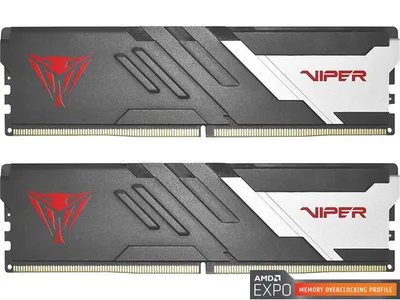
Two sticks, the right speed for AM5, both XMP and EXPO profiles, sold by Patriot's own store. Pair it with a 16GB graphics card and you have a build that is not short of memory anywhere.
The catch: CL36 is looser than the CL30 we pick at 32GB. In games the difference is a couple of percent; the dual-channel layout matters far more.
What we got wrong, and what could change this
Our June advice treated 32GB as the default because it was cheap insurance. We should have tied the advice to the price, and now we are. This post is not a lab test: the game results above come from TechSpot's and PC Gamer's published testing, and the prices are our own live Amazon reads. If DDR5 falls enough that 32GB costs less than about $120 more than 16GB, the trade-off disappears and we will say 32GB again. Every forecast we have read, from TrendForce to the memory makers themselves, says that will not happen in 2027. Until it does, 16GB of fast dual-channel DDR5 next to a 16GB graphics card is the better build for the same money.
Found this useful? Pass it along:
Frequently Asked Questions
Is 16GB of RAM enough for gaming in 2026?
For most games at 1080p and 1440p, yes, if it is two sticks running in dual channel and your graphics card has enough VRAM of its own. The games that need more than 16GB are mostly big simulation and extraction shooters like Escape from Tarkov, Stalker 2 and Microsoft Flight Simulator, plus newer releases whose recommended specs now list 32GB, such as Borderlands 4. If you mainly play those, buy 32GB.
Why is 16GB the new 32GB?
Because 32GB of DDR5 now costs about $240 more than 16GB, and most of the problems people blame on 16GB of RAM are really caused by 8GB graphics cards running out of VRAM and spilling game data into system memory. On November 10, 2026, upgrading from an 8GB RTX 5060 to a 16GB RTX 5060 Ti cost about $295 at Amazon. Spending the RAM money there fixes the cause rather than the symptom.
Should I buy 16GB or 32GB of RAM for a new PC?
Buy 32GB if the extra $240 does not push you down a graphics card tier, or if you stream, edit video, or play the memory-heavy games we list. Otherwise buy 16GB as a 2x8GB DDR5 kit now, put the difference into a 16GB graphics card, and add a second kit when memory prices come down.
Is 8GB of RAM enough in 2026?
No. Windows 11 and a browser use most of 8GB before a game starts, and almost every current game lists 16GB as its minimum. 16GB is the floor for any PC you plan to game on.
Can I add more RAM later?
Usually. On a four-slot motherboard you can add a second 2x8GB kit, though mixed kits do not always hold their rated speed together, so you may need to run them a step slower. On a two-slot board you would replace the kit instead. Either way, the 16GB you buy now is not wasted, since it can move to a second PC or be sold.